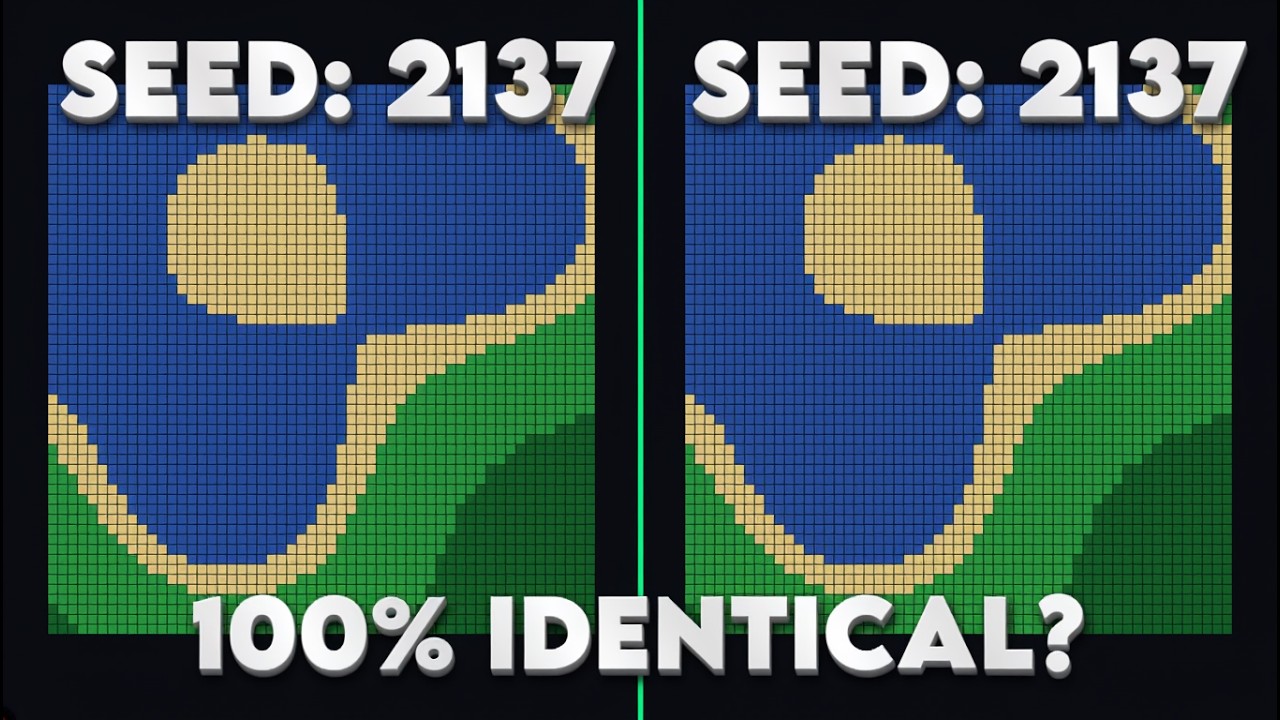
Imagine two players on two separate computers, thousands of miles apart. They type in the exact same four-digit number, hit generate, and end up in identical map layouts - finding the exact same loot chest in the exact same spot.
It is not a bug, and it is not a coincidence. How can a handful of digits hold thousands, or even millions, of pieces of data about an entire world?
The secret is that they don't. That single number is a game seed, and it relies on pure determinism to build vast procedural worlds out of thin air.
What Is a Seed?
In gaming, a seed refers to the specific starting conditions of a randomly generated world or run. It locks in the layout, encounters, items, and terrain before you take a single step. You see seeds everywhere: from custom world generation in Minecraft to seed-sharing options in roguelikes like Balatro, Slay the Spire, or The Binding of Isaac.
To understand how a seed works, you have to look at how computers handle randomness.
Computers cannot generate truly random numbers. Instead, they run mathematical algorithms (Pseudo-Random Number Generators, or PRNGs) that produce long sequences of numbers designed to look random.
Those algorithms always require an initial input to kick off the sequence: the seed.
Feed the algorithm the exact same seed, and it will output the exact same sequence of numbers every single time.
The Index Analogy
Think of a seed as an index for a giant, pre-written lookup table. If you feed an engine Seed 43, it jumps to line 43 of the algorithm's sequence. If line 43 dictates three lakes, a snowy mountain, and a dense forest, the engine draws those exact features. Switch to Seed 42, and the sequence changes. Switch back to 43, and the landscape snaps right back to its original state.
Scale that math up from a handful of terrain tiles to millions of blocks, and you get systems like Minecraft. The seed does not store the terrain data; it acts as the master key that tells the generator's algorithms where to place every biome, cave system, ore vein, and structure spawn. One number goes in; an entire explorable planet comes out.
The Math Behind Predictability: From Classic Engines to Modern Code
This rigid predictability has deep roots in computer science. Early random number generators relied on algorithms like Linear Congruential Generators (LCGs).
One infamous example from the 1960s - the RANDU algorithm - spit out numbers that looked random when viewed individually. However, when plotted in 3D space, the numbers aligned into distinct, visible planes rather than filling the space evenly:
Because of these predictable structural flaws, RANDU fell out of favor. Modern software often uses more sophisticated algorithms, such as the Mersenne Twister (found in Python's standard random library).
While modern PRNGs produce far better mathematical distributions, they remain fundamentally deterministic. If you observe just 624 consecutive outputs from a standard Mersenne Twister engine, you can fully reconstruct its internal state and predict every single number it will output from that point forward.
Game Design vs. Cryptography
In Video Games: Determinism is a massive feature. It keeps file sizes small and allows complex worlds to be shared via a tiny string of text.
In Cybersecurity: Determinism is a fatal vulnerability. Secure systems must pull true randomness from physical phenomena - such as keystroke timing, mouse movements, or atmospheric noise. Cloudflare famously films a physical wall of lava lamps, using the erratic movement of the wax as a source of cryptographically secure true randomness.
In game development, however, determinism is invaluable. If a player encounters a game-breaking bug, developers do not have to guess what happened - they simply load the player's seed, step into the exact same sequence of events, and debug the issue under identical conditions.
3 Clever Ways Seeds Are Used in Gaming
Once a seed provides a reproducible starting point, both developers and players can manipulate it in creative ways.
1. Daily Challenges
The "Daily Seed" is a staple of modern roguelikes like Spelunky, Balatro, and Slay the Spire. Every 24 hours, the game server assigns one specific seed to the entire player base. Everyone who logs in faces the exact same map layout, shop items, and enemy distribution, establishing a level playing field for daily leaderboards.
2. Community Seed Hunting
In games like Minecraft, The Binding of Isaac, or Enter the Gungeon, rare seeds become community trophies. Players run external tools that brute-force millions of seed values to find hyper-specific configurations - such as a world spawning rare items immediately at the starting location.
3. Speedrunning and Frame-Perfect RNG Manipulation
Seeds split speedrunning into distinct disciplines:
Set Seed Runs: Community members search for the most optimal map layout possible. Once found, all runners play on that identical world, transforming the category from a test of luck into a test of pure execution and muscle memory.
RNG Manipulation: In older titles like Pokémon Red, the initial seed is tied to the console’s internal frame counter upon booting up. Speedrunners exploit this by hitting soft-resets and menu inputs on precise frames - down to the millisecond. By controlling the exact frame the seed initializes, runners force the RNG state to guarantee high-stat encounters or bypass wild battles entirely.
Final Thoughts
Procedural generation can feel magical, but underneath the hood, it is purely deterministic math. Seeds bridge the gap between randomness and control, allowing developers to create infinite worlds out of tiny strings of data - and giving players a way to share those worlds with a single number.